Finance · Daily New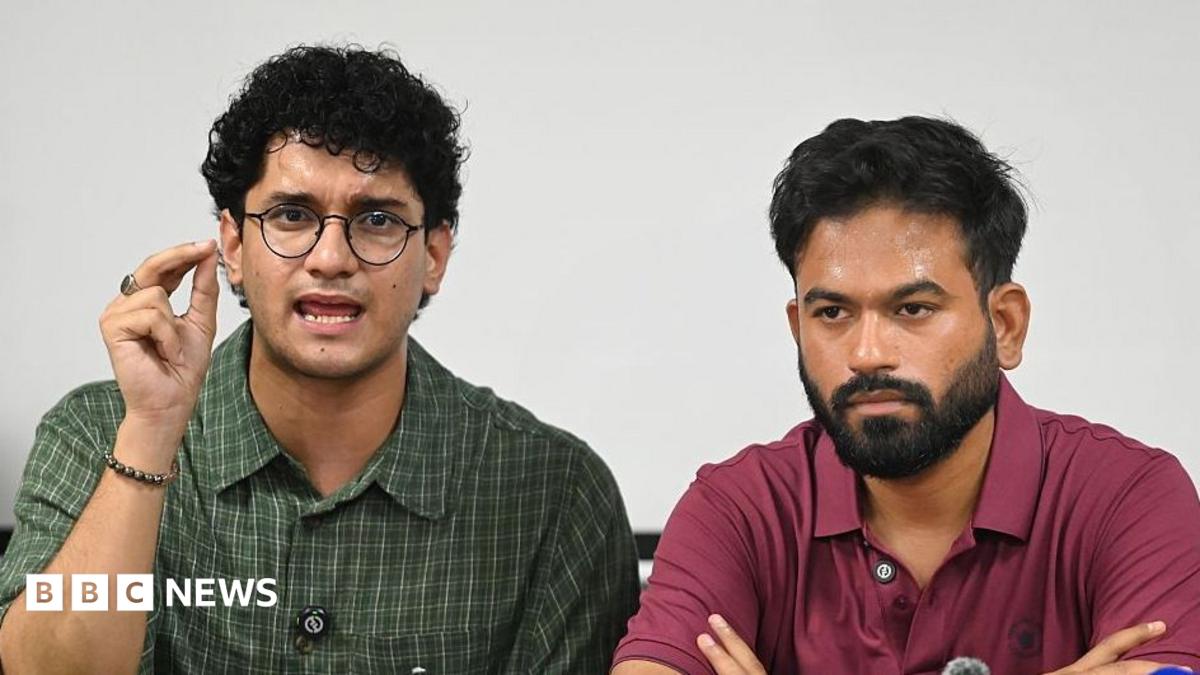
The faces of the CJP published at 07:40 BST As we have been reporting, the three main leaders of the CJP have been detained as they landed in Delhi. The best-known face from the protest is Abhijeet Dipke, the founder of CJP. Dipke, who recently completed a master's in public relations at Boston University, started the CJP almost as a joke in response to a stray comment by India’s Chief Justice Surya Kant.
However, it grew beyond’s anyone’s imagination and its first protest in Delhi ended with the resignation of a powerful federal minister. Image source, Hindustan Times via Getty Images Image caption, (From left) Saurav Das, Abhijeet Dipke and Ashutosh Ranka Other prominent faces include spokespersons and CJP co-convenors Ashutosh Ranka and Saurav Das. Ranka, who earlier worked with McKinsey & Co. in London, was once associated with the opposition Aam Aadmi Party He had also worked on issues related to education and public policy in his home state Rajasthan before joining the CJP.
Das, a former journalist who mainly covered legal issues and investigations, is now one of the CJP’s most recognisable faces. He is active on social media, where he often makes headlines with his sharp comments and replies to critics. All roads to the protest site sealed published at 07:34 BST Geeta Pandey Reporting from Jantar Mantar, Delhi Security continues to be extremely tight at Jantar Mantar, the planned protest site, where thousands of police and paramilitary personnel remain deployed.
The entire road has been sealed off with huge metal barricades, with no one allowed through, including journalists covering the protest. Drones can be seen flying overhead, while at some places, police officers have formed human chains to stop reporters from stepping onto the road. There is little sign of anyone being allowed anywhere near the protest site.
Abhijeet Dipke: the man behind the 'cockroach' movement published at 07:30 BST Just a few months ago, Abhijeet Dipke was a little-known 30-year-old student in Boston, spending his days watching documentaries and playing video games. Today, he's a familiar face in India, mobbed by supporters asking for selfies and leading a movement that has challenged Prime Minister Narendra Modi's government. Dipke, who previously worked with the opposition Aam Aadmi Party (AAP), had just completed a master's degree at Boston University when he posted a question on X in May: "What if all cockroaches come together?" Image source, Getty Images He says the post, written while playing a video game, was spontaneous.
It came after India's chief justice compared some unemployed young people to cockroaches - remarks he later said had been misinterpreted. The post went viral, and the Cockroach Janta Party was born. In July, Dipke watched from the stage as protesters celebrated the resignation of India's education minister.
A self-described introvert, Dipke has talked about how he would much rather be alone in his room. But for now, he is at the centre of one of India's most closely watched protest movements. Modi's BJP accuses opposition groups of trying to destabilise India published at 07:27 BST As the chaos around the protests continues, Prime Minister Narendra Modi’s Bharatiya Janata Party (BJP) has accused opposition groups of trying to destabilise India at the behest of foreign forces.
BJP president Nitin Nabin, speaking at a press conference in Delhi, described the opposition as "anarchic" and accused them of refusing to accept the people’s verdict and pursuing political agendas to create instability. He alleged that the associates of Congress party leader Rahul Gandhi and Aam Aadmi Party leader Arvind Kejriwal were leading Saturday's protests. He didn't name the CJP, which is the main organisation that called for protests - the CJP is not a registered political party but is a collective that now works as a pressure group.
Nabin said India was making progress despite global crises, adding that the opposition could not "digest India’s growth, progress, and advancement". He warned that their efforts would fail, saying: "Indian democracy possesses immense strength, and the patriots of this nation will unite to thwart your designs." Opposition parties, mainly the Congress, have been out on the streets this week, demanding the election chief's resignation. Some glimpses of central Delhi published at 07:17 BST As we’ve been reporting, thousands of police and paramilitary personnel have been deployed across Delhi, with people being detained near the protest site.
The heavy security presence is also affecting the city’s residents, who are having to deal with road diversions and much longer travel times. Image source, Getty Images Image caption, People who have managed to reach the protest site are being detained Image source, Reuters Image caption, A milkman being asked to take a different route amid diversions So where are the CJP leaders? published at 07:14 BST The Cockroach Janta Party (CJP) says its founder Abhijeet Dipke and two other leaders, Saurav Das and Ashutosh Ranka, were detained by police shortly after their flight from Mumbai landed in Delhi. In a video shared by the group, police officers appear to enter the aircraft, while Dipke can be heard saying he had expected to be arrested.
But what happened after that is less clear. We still don't know where the three men currently are. Police have not publicly explained the reasons for their detention.
And it's not just the CJP leadership. There are reports of many more people being detained across Delhi and elsewhere as police try to prevent protesters from gathering. Getting a clear picture of what's happening is also proving difficult, with mobile internet services suspended across parts of central Delhi.
For now, the whereabouts of Dipke and his colleagues remain unclear. We'll update you as we get more details. What is SIR and why is it controversial? published at 07:11 BST At the heart of today's protests is a simple but crucial question: who gets to vote in India?
The Election Commission is carrying out a massive check of voter lists, known as the Special Intensive Revision (SIR) which it says will weed out dead, duplicate or ineligible voters. Unlike routine updates, it involves officials going door to door to verify voters and draw up fresh lists. The exercise began in Bihar in June 2025 and has since spread to most of India.
And the numbers are striking. More than 130 million names - about 13% of India's electorate - have been left off draft voter lists across 30 states and federal territories. Critics fear eligible voters could lose their right to vote.
Opposition parties also accuse the government of using the exercise to check people's citizenship and benefit their party. The government denies this, while the Election Commission says SIR is simply about keeping voter lists accurate. Image source, Hindustan Times via Getty Images Why are these protests a big deal? published at 07:04 BST The protests have become a wider test for Prime Minister Narendra Modi’s government.
Saturday’s protests are the latest in a series of demonstrations that opposition parties have been doing - but given that the CJP is not a registered political party, its call is expected to attract people across all backgrounds, not just party supporters. The protests also come just months before crucial state elections, with the controversial electoral roll revisions giving opposition parties a strong issue to rally their supporters. It would also be a test of the CJP’s popularity - the last protests it held in Delhi forced a federal minister to step down.
The question now, experts say, is whether it can sustain that momentum. The government's response has raised the stakes further. Authorities have announced harsh travel restrictions, activists have been detained, and opposition leaders have also been pushed back and detained while protesting this week.
It's still unclear what will happen next. 'Not scared of going to jail' - CJP leader Dipke's message before detention published at 07:03 BST Hours before his detention, Cockroach Janta Party founder Abhijeet Dipke told media that even the prospect of jail or being charged under national security laws would not stop supporters of the movement. “We will continue to fight for democracy and will ensure [Cheif Election Commissioner] Gyanesh Kumar’s resignation,” he told news agency ANI. In a separate post on social media, he said the mass detention of protesters and the shutdown of Delhi were “not signs of strength, but of a leader terrified of his own people”. 'We were rote learning our lawyer's number' published at 06:58 BST Geeta Pandey Reporting from Jantar Mantar, Delhi One of the early protesters, Sabika Muzaffar, arrived with her mother at Jantar Mantar and said they expected to be detained.
“On the way to the protest site, instead of reciting hymns and verses as we usually do, my mother and I were rote learning our lawyer’s number.” She said that showing up to protest was "her way of defending the country and its democracy". A few minutes after the BBC spoke to Muzaffar, police took her away in what appeared to be a detention. Image caption, Sabika Muzaffar travelled from neighbouring Haryana state with her mother to take part in Saturday's protest Authorities responding at a 'different scale' published at 06:48 BST Azadeh Moshiri Reporting from Jantar Mantar, Delhi Thousands of protesters gathered in Mumbai last week for Cockroach Janta Party’s first large-scale protest since the summer.
Like today’s demonstration, it was unauthorised. But this time, the response from authorities is of a different scale. Beyond the heavy security presence, dozens of metro stations have been shut.
Loudspeakers have been blaring a reminder that there is a ban on gatherings of five people or more in parts of Delhi, and there are reports of reduced train services to the capital. On the eve of the protest, a group of senior lawyers told the Supreme Court this was an unprecedented “shutting down” of the capital. The police crackdown this summer on CJP protesters is still fresh in people’s minds.
Images of young protesters teargassed and hit with batons spurred an even larger turnout. I met parents who joined the protests, telling me they were there to protect the students around them. That experience will loom large today.
How the authorities handle any confrontation could shape the course of the days ahead. A capital under 'seige' published at 06:41 BST Geeta Pandey Reporting from Jantar Mantar, Delhi Delhi feels like it is under siege, with barricades and diversions on major roads leading to the city centre. A journey that would normally take 15 minutes took me an hour and 10 minutes this morning.
At Jantar Mantar, thousands of police and paramilitary personnel have been deployed. The main protest site has been cordoned off with metal barricades and ropes, keeping people out. Announcements asking people to cooperate with the police can be heard constantly over loudspeakers at the traffic roundabout.
Image caption, The protest site has been cordoned off Delhi has been turned into a fortress published at 06:38 BST Delhi had been put on high alert ahead of the protests, with thousands of security personnel deployed across the Indian capital. According to reports, around 23,000 central security personnel have been called in to assist the city police with maintaining law and order over the weekend. Police have put up barricades around Jantar Mantar - the planned protest site - and along roads leading to the Election Commission office and key buildings nearby.
More surprising are the larger restrictions - several trains to and from major Delhi stations have been cancelled and dozens of metro stations have been closed from Friday night. This means even people who don't plan to attend the protests will have a tough time travelling on Saturday. These restrictions remain in place despite the Supreme Court asking the Delhi Police on Friday not to inconvenience the people of Delhi by shutting down public transport.
Authorities have also closed liquor shops on Friday and Saturday as a “preventative” step to maintain public order. Delhi has seen large protests many times over the years, but it is rare for such overarching restrictions to be imposed. Image source, Reuters Image caption, Thousands of police and paramilitary personnel have been deployed in Delhi What is the CJP? published at 06:36 BST The Cockroach Janta Party, or CJP, started as an internet joke.
Founded in May by Abhijeet Dipke, the group emerged as a satirical collective after remarks by India's senior-most judge comparing some unemployed young people to cockroaches. But the joke soon turned serious, tapping into anger over unemployment, exam paper leaks and government accountability. The group made headlines with protests over alleged irregularities in a key medical entrance exam, forcing then-Education Minister Dharmendra Pradhan to resign in July.
Now, the CJP has a new target - India's Election Commission. It accuses the commission of unfairly removing eligible voters from electoral rolls – an allegation the organisation denies. Image source, NurPhoto via Getty Images Image caption, Protests led by the CJP ended with a rare resignation of a federal minister just two months ago What’s happening today? published at 06:34 BST Protesters are attempting to march to Jantar Mantar - an 18th century astronomical observatory and the Indian capital's best-known protest site - to demand electoral reforms and the resignation of Chief Election Commissioner Gyanesh Kumar.
They accuse Kumar of manipulating voter rolls to benefit Prime Minister Narendra Modi’s Bharatiya Janata Party (BJP). Both the Election Commission and BJP have denied this. The CJP’s protest call has been backed by several other organisations, so the expectation was of huge crowds reaching the site.
But police have been detaining people near Jantar Mantar, so we haven't seen any larger crowds yet. Many people may also be deterred by the heavy travel restricitons and police presence in place across the city. Image source, Reuters Image caption, The police have cordoned off protest site Jantar Mantar Welcome to the BBC’s live coverage published at 06:34 BST India's Gen Z-led Cockroach Janta Party says its main leaders, including founder Abhijeet Dipke, have been detained from the Delhi airport on their way to a protest march in the city.
The government or Delhi Poice have not commented on the CJP's claim yet. Dozens of others have also been detained in Delhi, while many people have been stopped on their way to attend the protest. Protesters are demanding the resignation of Chief Election Commissioner Gyanesh Kumar and calling for electoral reforms.
Security has been tightened across Delhi, with restrictions in place in several areas. Stay with us as we bring you live updates throughout the day.
Source: BBC